Benefits of sales funnel
Make it easy for buyers to find your content and learn about your offerings and buy. Increase your revenue while saving time for your clients by creating a good sales funnel.
How to Optimize Your Sales Funnel for Business Growth
A sales funnel improves when it reflects how buyers actually move, pause, and decide. Growth happens when you can remove situations where your customer’s interest drops and their intent loses clarity. This is when the sales funnel optimization should begin. Below are the ways to optimize your sales funnel:
Read Behavior Before Changing Process
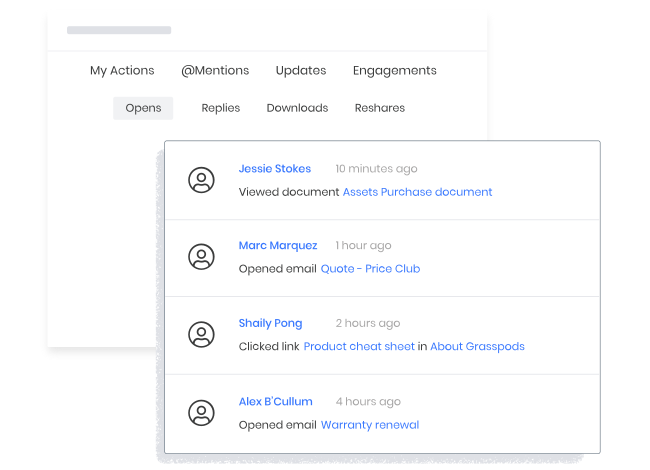
Prospects reveal readiness through small actions. The questions they ask. The material they revisit. The speed of their replies. These signals matter more than activity volume. When teams adjust their approach based on these signals, follow ups feel relevant instead of forced.
Set Conditions for Progress
Funnels break when every interaction moves a deal forward by default. Progress works better when movement depends on clear buyer actions. A proposal makes sense only after alignment is visible. A demo works only when a real use case is discussed. These conditions keep momentum honest.
Revisit Bottlenecks Often
Markets shift quietly. A stage that worked six months ago may now stall deals. Regularly reviewing of where prospects slow down helps teams fix issues early. Long pauses usually point to missing information or unclear value, not lack of interest.
Real-World Sales Funnel Examples
Funnels change shape depending on how buyers evaluate risk, cost, and commitment. The same structure rarely works across industries.
B2B SaaS
SaaS buyers rarely move in straight lines. Technical teams want proof. Business teams want outcomes. Leadership wants certainty. Deals move forward, then pause, then circle back. Funnels here must support repeated evaluation without losing context. Pressure at the wrong moment resets progress.
Professional Services
Here, the funnel often starts midway. Awareness already exists through referrals or reputation. Early stages compress quickly. Most friction appears during consideration, where buyers judge experience, credibility, and working style. Trust decides speed more than pricing.
E-commerce and D2C
Consumer funnels move fast. Interest and intent often happen together. Small frictions cause immediate exits. Buyers compare quickly and decide quickly. The funnel works when information is clear, and checkout feels easy. Delays or hidden steps instantly kill momentum.
Manufacturing and Industrial Sales
These funnels stretch across time. Multiple teams weigh in. Documentation matters more than persuasion. Evaluation takes longer because mistakes carry operational consequences. Progress depends on clarity around specifications, timelines, and reliability rather than excitement.
Key Differences Between B2B and B2C Sales Funnels
B2B and B2C sales funnels often use the same labels, but they behave very differently in practice. The difference does not come from the product alone. It comes from how decisions are made, how risk is assessed, and how much internal coordination is required before a purchase can happen.
B2B Sales Funnel
- Decision making is distributed across multiple roles rather than concentrated with a single buyer. Progress depends on coordination and agreement between stakeholders.
- Buying cycles tend to extend over longer periods. Movement between stages is often interrupted by internal reviews, budget planning, or shifting priorities.
- Risk is evaluated at an organizational level. Choices are assessed for their operational impact, long-term viability, and alignment with existing systems.
- Evaluation focuses on justification and feasibility. Buyers examine return expectations, implementation effort, and reliability before advancing.
- Funnel movement is non-linear. Prospects may revisit earlier stages as new participants enter or additional information is requested.
- Changes in momentum are usually caused by unresolved questions rather than lack of interest.
B2C Sales Funnel
- Decision making is individual. A single buyer controls progression through the funnel without formal approval layers.
- Buying cycles are short and compressed. Interest, evaluation, and purchase often occur within a narrow time window.
- Risk is perceived as personal and limited. Buyers expect flexibility and are comfortable reversing decisions if needed.
- Evaluation centers on clarity and immediacy. Price, availability, and visible benefits influence movement more than long-term analysis.
- Funnel movement is mostly linear. Buyers either proceed through the stages or exit the funnel entirely.
- Drop-offs usually reflect loss of interest rather than unresolved evaluation.
Best Practices for Building an Effective Sales Funnel
Strong funnels are designed around discipline, not optimism. They work when teams agree on what progress looks like and respect buyer timing.
Align Revenue Teams Early
Funnels weaken when marketing, sales, and post sale teams operate with different assumptions. Clear agreement on stage meaning, handoffs, and ownership reduces confusion for both teams and buyers. Alignment improves forecast reliability and buyer confidence.
Qualify With Intent, Not Enthusiasm
Interest alone does not justify advancement. Effective teams are defined by readiness, authority, and urgency. This protects time and prevents late stage surprises. Funnels perform better when effort follows intent.
Match Value to Buyer Stage
Buyers do not need the same information throughout the journey. Early conversations focus on relevance. Later conversations focus on feasibility and outcomes. When messaging stays static, deals stall. Adapting value delivery keeps conversations moving.
Govern Using Momentum Signals
Healthy funnels track how deals move, not just how many exist. Time spent in stage, re entry patterns, and stalled transitions reveal more than surface metrics. These signals guide adjustment without overreaction.
Learn From Closed and Lost Deals
Every closed deal and every lost deal carries usable insight. Patterns emerge when teams review them honestly. Over time, this shapes a funnel that reflects real buying behavior rather than theoretical models.